Course Description & Grading Policy | Lecture Schedule | Lab Policy | Lab Schedule | Office Hours | Old Exams
Announcement |
.gif?sfvrsn=d4573535_1)
Phys 101 Course Description & Grading Policy (Term 261)
Course Description:
Textbook:
Teaching Method:
The course material will be presented in lectures (3 hrs. per week). Problem-solving techniques will be shown in recitations (1 hr. per week). Understanding concepts from lectures will be strengthened through lab work (3 hrs. per week). Lectures and recitations will start from the first week.
Course Learning Outcomes: On successfully completing the course the students can:
Attendance Policy:
Assessment:
| Grading Policy | Points | % |
| Class Work | 50 | 12.5 |
| Lab Work | 50 | 12.5 |
| First Major Exam (120 minutes), 20 MCQ | 100 | 25 |
| Second Major Exam: (120 minutes), 20 MCQ | 100 | 25 |
| Final Exam (Comprehensive, 120 minutes), 20 MCQ | 100 | 25 |
| Total | 400 | 100 |
Make-up Exam Policy:
A student who misses an exam with a valid excuse must present an officially authorized excuse (issued by KFUPM’s Student Affairs) to the course coordinator within 3 days after the date of the exam to take a make-up exam. However, if the student misses the final exam with a valid excuse, he/she will get an “IC” grade in the course and will take a make-up exam in the following semester. If the student does not have a valid excuse issued by KFUPM’s Student Affairs, the score for that exam will be zero. Personal excuses are not accepted.
Phys 101 Lecture Schedule – Fall Semester 2026-2027 (Term 261)
| Week | Day | Date | Topics | Chapter | Sec |
|---|---|---|---|---|---|
| 1 | Thu | Aug 20 | Measuring things, including lengths | 01 | 1 |
| 2 | Sun Tue Thu | 23 25 27 | Length, time, mass, (powers of ten), Dimensional Analysis Displacement, Velocity, and Acceleration Constant acceleration, Free fall, Graphical Integration | 01 02 02 | 2,3 1-3 4-6 |
| 3 | Sun Tue Thu | 30 Sep 1 3 | Vectors and unit vectors, adding vectors by their components. Multiplying Vectors Review | 03 03 -- | 1,2 3 -- |
| Tuesday Sept. 1, 2026 – Last day for dropping courses without a permanent record | |||||
| 4 | Sun Tue Thu | 6 8 10 | Displacement, Velocity, and Acceleration in 2D and 3D Projectile motion, Uniform circular motion Relative Motion in 1D and 2D | 04 04 04 | 1-3 4,5 6,7 |
| 5 | Sun Tue Thu | 13 15 17 | Newton's first and second laws Some particular forces Applying Newton’s Laws | 05 05 05 | 1 2 3 |
| 6 | Sun Tue | 20 22 | Friction Uniform Circular Motion | 06 06 | 1 3 |
| National Day Holiday (Sep 23 & 24) First Major Exam (Chapters 1-6): Sep 27, 2026 at 7:00 – 9:00 PM, Building 54 | |||||
| 7 | Sun Tue Thu | 27 29 Oct 1 | Review Kinetic Energy and Work Work done by gravity, Spring, Power | -- 07 07 | -- 1, 2 3,4,7 |
| 8 | Sun Tue Thu | 4 6 8 | Potential energy, Conservation of mechanical energy Work by an external force, Conservation of energy Center of mass, Newton’s second law for a system of particles | 08 08 09 | 1, 2 4, 5 1,2 |
| 9 | Sun Tue Thu | 11 13 15 | Linear momentum, collision, and impulse Conservation of linear momentum, kinetic energy in a collision Collisions in 1-D and 2-D | 09 09 09 | 3,4 5,6 7,8 |
| 10 | Sun | 18 | Review | -- | -- |
| Midterm Break (Oct. 20- Oct. 22) | |||||
| 11 | Sun Tue Thu | 25 27 29 | Rotational Variables, Const. angular acceleration, Linear to rotation Kinetic energy and rotational inertia Torque, Newton’s 2nd law, and work in rotational motion | 10 10 10 | 1-3 4,5 6-8 |
| Thursday Oct. 29, 2026: Last day of dropping course(s) with grade “W” thru KFUPM portal | |||||
| 12 | Sun Tue Thu | Nov 1 3 5 | Rolling motion Torque and angular momentum, Newton’s 2nd law in angular form Rigid body rotation and conservation of angular momentum | 11 11 11 | 1-3 4-6 7-8 |
| Second Major Exam (Chapters 7-11): Nov 10, 2026 at 7:00 – 9:00 PM, Building 54 | |||||
| 13 | Sun Tue Thu | 8 10 12 | Review Review Static equilibrium of rigid bodies | -- -- 12 | -- -- 1,2 |
| 14 | Sun Tue Thu | 15 17 19 | Elasticity Newton’s law of gravitation, Principle of superposition Gravitation near and inside Earth, Gravitational potential energy | 12 13 13 | 3 1,2 3-5 |
| Autumn Break (Nov. 22 - 23) | |||||
| 15 | Tue Thu | 24 26 | Kepler's laws, Satellites Fluids, Density and pressure, Fluids at rest, Measuring pressure | 13 14 | 6,7 1-3 |
| 16 | Sun Tue Thu | 29 Dec 1 3 | Pascal’s principles, Archimedes principle Continuity equation, Bernoulli's equation Simple harmonic motion (SHM) | 14 14 15 | 4,5 6,7 1 |
| 17 | Sun Tue Thu | 6 8 10 | Energy in SHM, Pendulums Review Review | 15 -- -- | 2, 4 -- -- |
| Final Exam (Chapters 1 – 15): TBA | |||||
I wish you a successful semester. PHYS101 Coordinator: Dr. Khan Alam
Phys 101 Lab Policy (261)
Grading Policy
- The lab grade counts for 50 of 400 points (12.5% of the PHYS101/102 course grade).
- The grade is based entirely on lab reports (no quizzes).
- The average for each lab section is 40 out of 50.
- Students' lab reports should be graded and returned to students within one week of submission.
Lab Attendance Policy
- The student must arrive at the lab on time. Latecomers may not be allowed into the lab.
- A DN grade shall be given to any student with 3 or more unexcused absences in the lab. A DN grade shall also be given if the student has a total of 5 excused and/or unexcused absences.
- Students are responsible for coordinating with the lab instructor to make-up a missed lab if they are absent with an official excuse; otherwise, they will receive a zero for that lab. The only exception applies when the excused absence occurs on the last lab day of the week, making it impossible for the student to attend a makeup lab with another section. In such a case, the student’s average lab grade will be assigned to the missed lab.
- The instructor may allow students who were absent with an official excuse to attend a make-up lab in another section. A student may not attend another section for a make-up without written permission from their lab instructor. Personal excuses are not accepted. Only excuses from Student Affairs (the blue letter with a QR code) are accepted.
- During the lab session, the student is not allowed to leave the lab without the lab instructor's permission. Otherwise, the student will be considered absent.
General lab policy
- It's the student’s responsibility to check the lab grades with the instructor before it is submitted to the coordinator. Once submitted, it will not be changed.
- Using mobile phones is not allowed in the labs. Students should keep their phones in their pockets or bags. Any student showing a phone should be considered a cheating case.
- Students must bring the supplies they need, such as a lab notebook (graph notebook), pencil, ruler, calculator, and eraser.
- Students will download the write-up for each experiment from the PHYS101/102 website (Lab Schedule).
- Students will read the write-up, conduct the experiment, then write the report in their notebooks.
- Students are expected to work in groups during data collection. Then, each student has to write their own report and answer the questions individually, without sharing it with others. Any cheating, copying, or sharing of lab reports will result in severe consequences according to the university policy.
- Students should complete their lab work during the lab session, and the instructor must collect all the reports before leaving the lab.
- According to the Labs' safety guidelines, food and beverages are not allowed in the Labs.
- The student must leave the lab space clean and tidy, return the tools to their boxes, and disconnect any electrical wires before leaving.
Phys 101 Lab Schedule (Term 261)
| Week | Date | Write-Up | Data Studio File |
|---|---|---|---|
| 1 | Aug 19 -20 | NO LAB | |
| 2 | 23-27 | NO LAB | |
| 3 | Aug 30 - Sep 3 | Significant Figures Significant F Report | |
| Tuesday Sept. 1, 2026 – Last day for dropping courses without a permanent record | |||
| 4 | 6-10 | Graphing | |
| 5 | 13 - 17 | Vectors | |
| 6 | 20 - 24 | NO LAB - National Day Holiday (Sep 23 & 24) | |
| First Major Exam (Chapters 1-6): Sep 27, 2026 at 7:00 – 9:00 PM, Building 54 | |||
| 7 | Sep 27 – Oct 1 | Constant Acceleration | |
| 8 | 4 - 8 | Newton's Laws | NewtonEx1 NewtonEx2 NewtonEx3 |
| 9 | 11 - 15 | Spring | Spring |
| 10 | 18 - 22 | NO LAB - Midterm Break (Oct. 20- Oct. 22) | |
| 11 | 25 - 29 | Inelastic Collision | Ballistic.ds |
| Thursday Oct. 29, 2026: Last day of dropping course(s) with grade “W” thru KFUPM portal | |||
| 12 | Nov 1 - 5 | Rotational Inertia | Rotation1.ds Rotation2.ds Rotation3.ds |
| Second Major Exam (Chapters 7-11): Nov 10, 2026 at 7:00 – 9:00 PM, Building 54 | |||
| 13 | 8 - 12 | Maxwell's Wheel | Maxwell Wheel.ds |
| 14 | 15 - 19 | Density | |
| 15 | 22 - 26 | NO LAB - Autumn Break (Nov. 22 - 23) | |
| 16 | Nov 29 – Dec 3 | Simple Pendulum | |
| 17 | 6 - 10 | NO LAB | |
| Final Exam | |||
I wish you a successful semester. PHYS101 Lab Coordinator: Ayman Ghannam
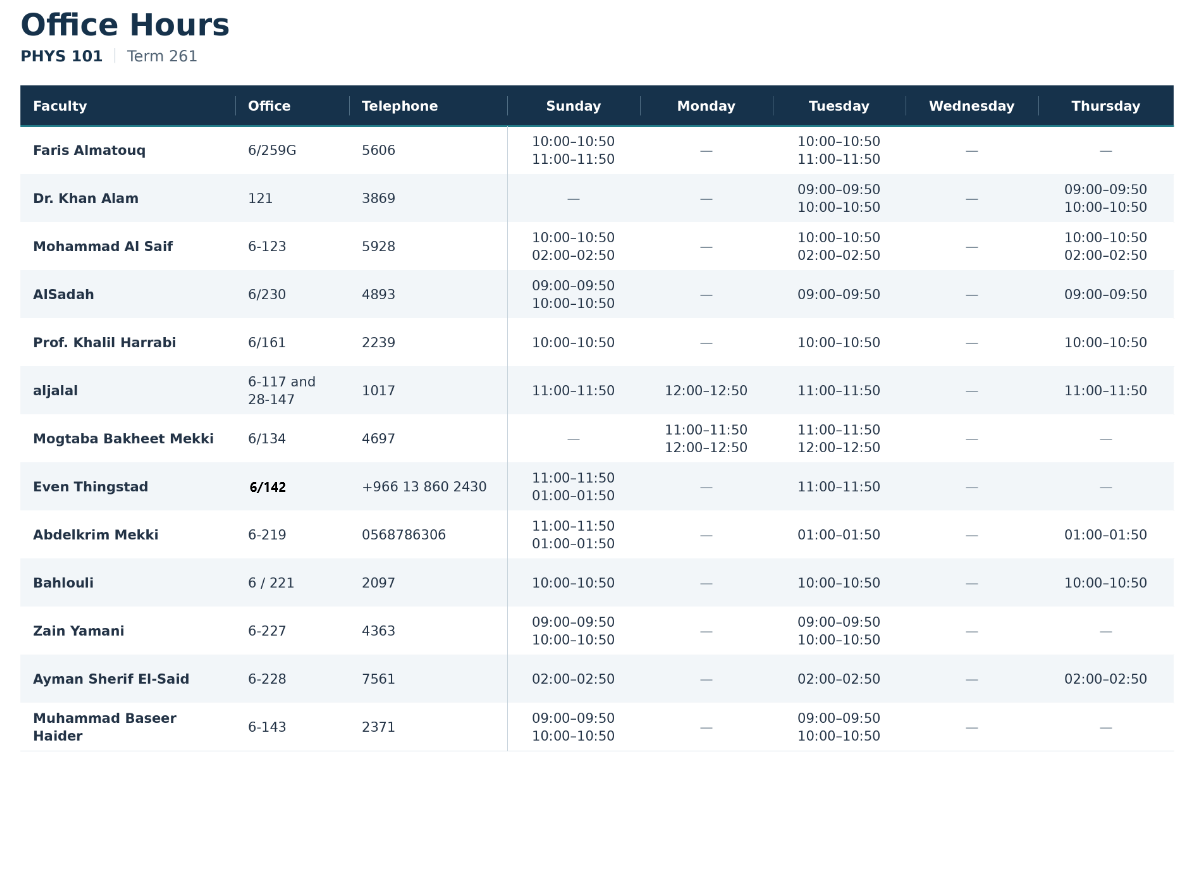
Office Hours - Term 261
Need Help in PHYS 101?
You are encouraged to seek help from any instructor teaching phys101 even if he is not your instructor.
Go to the top.