Welcome To KFUPM Physics

Welcome to the Department of Physics at King Fahd University of Petroleum and Minerals. I invite you to explore our website where you can find information about our academic programs, courses, research activities, and faculty members. Physics has always been at the forefront of exploration. This is accomplished through cognitive enhancement by education transmitted through academic courses as well as carrying out research at the cutting-edge frontiers of human knowledge. The Physics department offer courses that are solidly based on the American system to meet international quality assurance requirements, which has placed the Department as a world-class regional center in a leading international institution. Our student body includes pure-physics students and double-major students, which reflects the interdisciplinary nature of our program. In addition, our research facilities span various fields of physics including condensed matter physics, lasers, materials research, magnetism and superconductivity, nuclear physics, and nonlinear and computational physics. Over the past five decades, our faculty members have conducted research using in-house facilities as well as collaborative research with national and international centers.

Mohammad Al-Kuhaili,
Professor & Chairman, Physics Department

Research

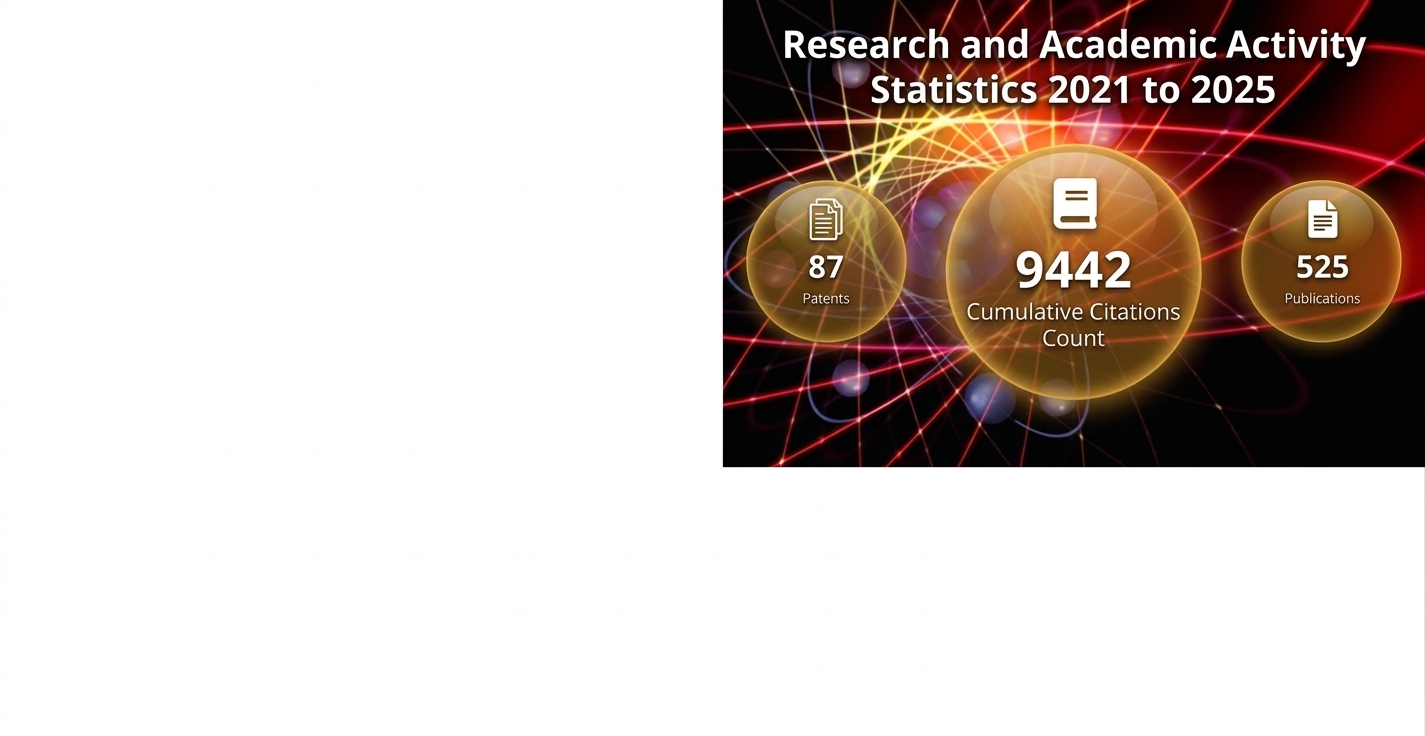
Research and Academic activity statistics 2015 to 2021

Average Impact Factor Publications​

Patents

Cumulative Citation Count​

Publications

Recent News

View all news

Recent Events

View all events
SEMINAR

Organic cations and crystal defects in hybrid perovskites


Speaker:

Prof. Udo Schwingenschloegl(KAUST)


Date: Monday, August 31st, 2026
Time: 11:00 a.m.
Location: Bldg. 6/Room 125

Abstract:

The photoconversion efficiency record of silicon-perovskite solar cells exceeds 30% owing to hybrid perovskites ΆPbX3 with organic cations Ά that stabilize the perovskite sublattice not only by ionic bonding but also by non-covalent bonding (that is absent in all-inorganic perovskites). As the lowest-energy electronic transitions mainly involve orbitals of the inorganic skeleton, the optoelectronic properties are determined by the halogen composition X, PbX6 tiltings and rotations, and bulk and surface defects. The main drawbacks of hybrid perovskites are their intrinsic instability towards photoinactive δ-phases and degradation by light, heat, oxygen, and moisture, for example. We address the stability issue from the perspectives of the bulk crystal phases, point defects, and surfaces and interfaces. It is shown that the softness of the lattice allows various organic cations to fit into and bond stronger with the inorganic skeleton than methylammonium and formamidinium, enabling mixed-cation compositions of higher stability.

Biography:

Dr. Udo Schwingenschlögl is a Professor of Materials Science and Engineering & Applied Physics at King Abdullah University of Science and Technology (KAUST). Prior to joining KAUST in 2009, he worked at the International Center of Condensed Matter Physics in Brasilia, Brazil, and the University of Augsburg, Germany. His research interests in condensed matter physics and first-principles materials modeling focus on 2D materials, interface and defect physics, correlated materials, thermoelectric materials, metal-ion batteries, nanoparticles, and quantum transport.

 All faculty, researchers and students are invited to attend.

    Location and Time
  • 6/125

  • 31 Aug, 2026

  • 11:00 AM - 12:00 PM