Welcome To KFUPM Physics

Welcome to the Department of Physics at King Fahd University of Petroleum and Minerals. I invite you to explore our website where you can find information about our academic programs, courses, research activities, and faculty members. Physics has always been at the forefront of exploration. This is accomplished through cognitive enhancement by education transmitted through academic courses as well as carrying out research at the cutting-edge frontiers of human knowledge. The Physics department offer courses that are solidly based on the American system to meet international quality assurance requirements, which has placed the Department as a world-class regional center in a leading international institution. Our student body includes pure-physics students and double-major students, which reflects the interdisciplinary nature of our program. In addition, our research facilities span various fields of physics including condensed matter physics, lasers, materials research, magnetism and superconductivity, nuclear physics, and nonlinear and computational physics. Over the past five decades, our faculty members have conducted research using in-house facilities as well as collaborative research with national and international centers.

Mohammad Al-Kuhaili,
Professor & Chairman, Physics Department

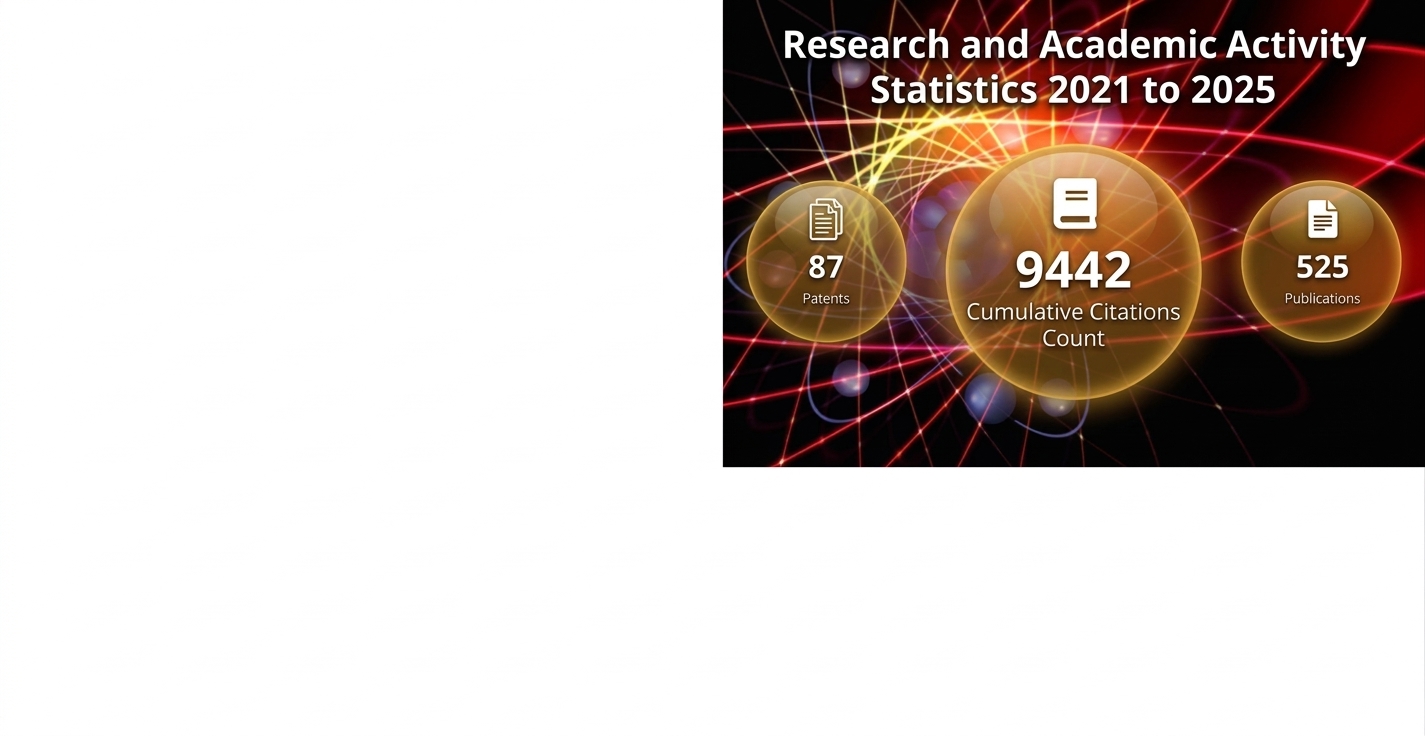
Research and Academic Activity Statistics 2021 to 2025

Average Impact Factor Publications​

87

Patents

 9442

Cumulative Citation Count​

525

Publications

Recent News

View all news

Recent Events

View all events
Seminar


Catching Solar Flares with ESA’s Solar Orbiter Mission


Speaker:

Prof. Säm Krucker
University of Applied Sciences Northwestern Switzerland (FHNW)
Date: Monday, November 30, 2026
Time: 11:00 AM
Location: Bldg. 6/Room 125

Abstract:

The ESA’s Solar Orbiter mission provides unique observations of our Sun from radial distances as close as 0.29 AU with a set of in-situ and remote sensing instruments.  In this seminar I report on the latest efforts of catching solar flares with Solar Orbiter’s remote sensing instruments in EUV and X-rays by carefully planning dedicated campaigns (‘Solar Flare Watch’). After an introduction to the physics of solar flares, I will highlight the latest results on the fragmented nature of the magnetic energy release processes in solar flares with show typical size scales of below 150 km and time scales of a few seconds. Hence, a solar flare does not have a single energy release site, but it consists of many energy releases from different locations flaring at different times.


Biography:

My main scientific interests are in problems of plasma astrophysics, especially solar and heliospheric physics, from an observational and experimental point of view. Over the past three decades, I have been working on problems of how the solar corona is heated, how magnetic energy is converted, how energetic particles are accelerated and how they escape from acceleration sites into interplanetary space. Through my University of California Berkeley affiliation, I have been the Principal Investigator (PI) of the NASA Small Explorer mission RHESSI and the NASA sounding rocket missions FOXSI. Through my Swiss affiliation, I am currently the PI of the X-ray telescope STIX onboard ESA’s Solar Orbiter mission.

 All faculty, researchers and students are invited to attend.

    Location and Time
  • 6/125

  • 30 Nov, 2026

  • 11:00 AM - 12:00 PM