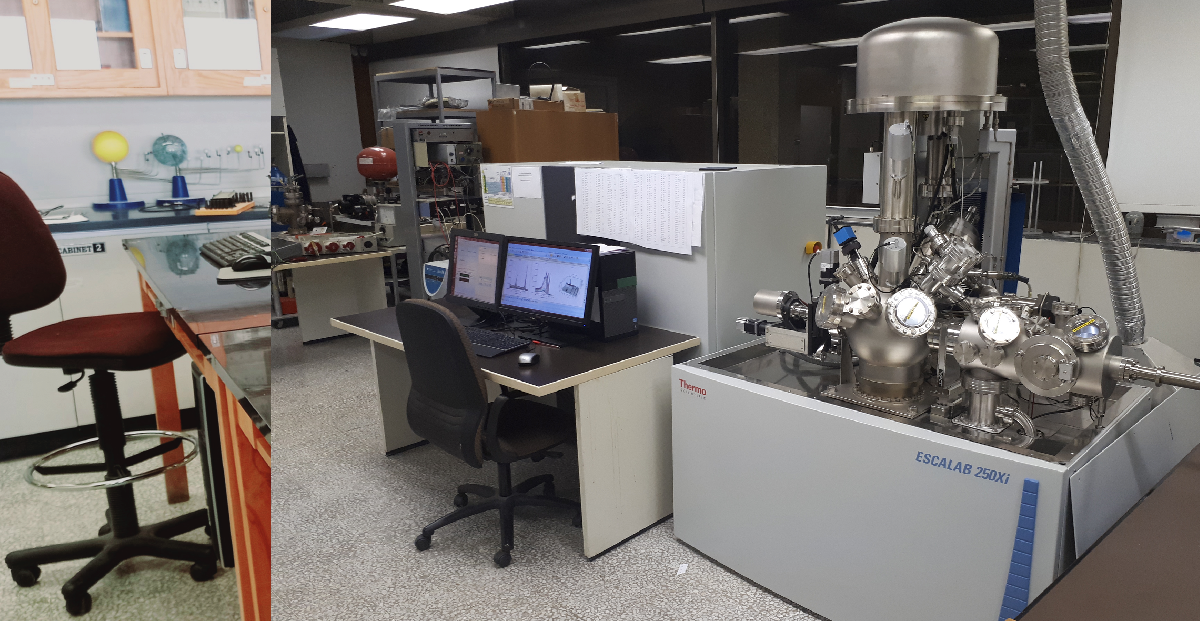
Welcome To KFUPM Physics

Welcome to the Department of Physics at King Fahd University of Petroleum and Minerals. I invite you to explore our website where you can find information about our academic programs, courses, research activities, and faculty members. Physics has always been at the forefront of exploration. This is accomplished through cognitive enhancement by education transmitted through academic courses as well as carrying out research at the cutting-edge frontiers of human knowledge. The Physics department offer courses that are solidly based on the American system to meet international quality assurance requirements, which has placed the Department as a world-class regional center in a leading international institution. Our student body includes pure-physics students and double-major students, which reflects the interdisciplinary nature of our program. In addition, our research facilities span various fields of physics including condensed matter physics, lasers, materials research, magnetism and superconductivity, nuclear physics, and nonlinear and computational physics. Over the past five decades, our faculty members have conducted research using in-house facilities as well as collaborative research with national and international centers.

Mohammad Al-Kuhaili,
Professor & Chairman, Physics Department

Research and Academic activity statistics 2015 to 2021

3.1

Average Impact Factor Publications​

51

Patents

10042

Cumulative Citation Count​

452

Publications

Recent News

View all news

Recent Events

View all events
Seminar

Understanding the Insulator to Metal Transition in VO2 Thin Films and Its Potential Applications

Speaker
Dr. Suhail Majid
Postdoc Fellow, Physics Department
Date: Monday, 02 February 2026
Time: 11:00 a.m.
Location: Bldg. 6/Room 125

Abstract:
Vanadium dioxide (VO2) has posed many lingering questions about the origin of its characteristic insulator to metal transition (IMT). VO2 is known to undergo first order IMT around the transition temperature 340 K, accompanied by the structural transition from the rutile (R) metallic to the insulating monoclinic (M1) phase. The nature of the IMT in VO2 has remained controversial whether Peierls assisted or correlation driven involving electron-lattice and electron-electron interactions, respectively. VO2 exhibits several insulating phases (monoclinic M1, M2, and triclinic T), and the study of these phases is important for understanding the true nature of the IMT in VO2. These insulating phases have small but discernible crystallographic differences in the vanadium chains forming the dimers.

We have studied structural, electrical, ultrafast-reflectivity, and electronic structure properties of the T-phase Cr-doped VO2 and the M1-phase pure VO2 thin films, both grown by pulsed laser deposition under identical conditions. An intermediate M2 structure is observed in the Cr-doped VO2, while the pure VO2 directly goes from the insulating monoclinic M1 structure to a metallic rutile R structure, manifested by temperature-dependent Raman spectroscopy.

The IMT in VO2 is accompanied by a transition from infrared (IR) transparent (insulating phase) to IR opaque (metallic phase). A decrease in the IR transmittance of the VO2 with an increase in the temperature is directly associated with the vanishing of the VO2 insulating band gap. Bandgap in VO2 mainly arises due to the V-V dimerization and the strong electron correlations present within the V-V dimers. Transition in IR transmittance makes VO2 a potential candidate for the manufacturing of energy-saving smart thermochromic windows. Tailoring of the IMT and associated optical properties was made possible via electron-doped (W) and hole-doped (Tb) atoms.

Biography:
Dr. Suhail Majid is currently working as a Postdoc Fellow at the Department of Physics, KFUPM, Saudi Arabia. He did his Ph.D. from Aligarh Muslim University in joint collaboration with UGC-DAE CSR, Indore, India. He has studied the electronic structure of novel oxide-based thin films using synchrotron sources at RRCAT and DSEY, Germany, and conducted postdoctoral research at Academia Sinica, Taiwan, where he worked in the area of high-pressure ultrafast Physics to explore the dynamics of materials at high pressure and on an ultrafast timescale.

Dr. Suhail has worked in the field of experimental condensed matter physics, studied novel materials meant for both physics understanding and technological applications. He has worked on various transport, optical, and spectroscopic techniques during his research tenure.


All faculty, researchers and students are invited to attend.

    Location and Time
  • 6/125

  • 02 Feb, 2026

  • 11:00 AM - 12:00 PM