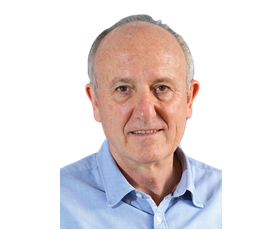
Dr. Daniel Loss
Chair Professor and Center Director
Brief Research Interests
Condensed matter theory
Research Area
Condensed matter theory and quantum computing
Affiliated Center
Advanced Quantum Computing Center
Research Interests
Quantum theory of condensed matter systems, specializing in spin-dependent and phase-coherent phenomena across semiconducting nanostructures, molecular magnets, and hybrid quantum systems. A central highlight of his research was pioneering the foundational Loss-DiVincenzo proposal for quantum computing using spin qubits, an innovation that continues to drive global experimental and theoretical progress in solid-state quantum information processing. His broader research program investigates spin dynamics, decoherence mechanisms, topological quantum states—such as Majorana fermions and skyrmions—spintronics, and quantum transport phenomena in low-dimensional and nanoscale magnetic systems.
Biographical Sketch
Daniel Loss earned his Ph.D. in Theoretical Physics at the University of Zurich in 1985, followed by postdoctoral research at UIUC and IBM Research, before joining Simon Fraser University as an Assistant and Associate Professor. In 1996, he returned to Switzerland to become Full Professor of Theoretical Physics at the University of Basel. Over his distinguished career, he has served as Director of the Basel Center for Quantum Computing, Team Leader at the RIKEN Center for Quantum Computing in Japan, and Co-Director of the NCCR SPIN QUBITS IN SILICON. In 2025, he joined King Fahd University of Petroleum & Minerals (KFUPM) as Chair Professor of Quantum Computing and Founding Director of the Quantum Center.
Awards & Honors
- Marcel Benoist Prize (2010),
- Humboldt Research Prize (2005),
- Blaise Pascal Medal (2014),
- The King Faisal International Prize in Science (2017).
- Honored with the E-MRS Czochralski Gold Medal (2024) for lifetime achievements and elected as an External Scientific Member of the Max Planck Society (2021).
- Named a Clarivate Citation Laureate in Physics (2025) for proposing the groundbreaking Loss-DiVincenzo model for quantum computing with spin qubits in quantum dots.
KEY PUBLICATIONS
- Loss, D. and DiVincenzo, D. P., “Quantum computation with quantum dots,” Physical Review A. Vol. 57, No. 1, pp. 120-126, (1998).
- Leuenberger, M. N. and Loss, D., “Quantum computing in molecular magnets,” Nature. Vol. 410, No. 6830, pp. 789-793,(2001).
- Imamoğlu, A., Awschalom, D. D., Burkard, G., DiVincenzo, D. P. and Loss, D., “Quantum information processing using quantum dot spins and cavity QED,” Physical Review Letters. Vol. 83, No. 20, pp. 4204-4207, (1999).
- Burkard, G., Loss, D. and DiVincenzo, D. P., “Coupled quantum dots as quantum gates,” Physical Review B. Vol. 59, No.3, pp. 2070-2078, (1999).
- Trauzettel, B., Bulaev, D. V., Loss, D. and Burkard, G., “Spin qubits in graphene quantum dots,” Nature Physics. Vol. 3,No. 3, pp. 192-196, (2007).
- Schliemann, J., Egues, J. C. and Loss, D., “Nonballistic spin-field-effect transistor,” Physical Review Letters. Vol. 90, No.14, pp. 146801, (2003).
- Khaetskii, A. V., Loss, D. and Glazman, L., “Electron spin decoherence in quantum dots due to interaction with nuclei,” Physical Review Letters. Vol. 88, No. 18, pp. 186802, (2002).
- Bravyi, S., DiVincenzo, D. P. and Loss, D., “Schrieffer–Wolff transformation for quantum many-body systems,” Annals of Physics. Vol. 326, No. 10, pp. 2793-2826, (2011).
- Klinovaja, J., Stano, P., Yazdani, A. and Loss, D., “Topological superconductivity and Majorana fermions in RKKY systems,” Physical Review Letters. Vol. 111, No. 18, pp. 186805, (2013).
- Prada, E., San-Jose, P., de Moor, M. W. A., Geresdi, A., Lee, E. J. H., Klinovaja, J., Loss, D., Nygård, J., Kouwenhoven,L. P. and Yeyati, A. L., “From Andreev to Majorana bound states in hybrid superconductor–semiconductor nanowires,” Nature Reviews Physics. Vol. 2, No. 10, pp. 575-594, (2020).
- Recher, P., Sukhorukov, E. V. and Loss, D., “Andreev tunneling, Coulomb blockade, and resonant transport of nonlocal spin-entangled electrons,” Physical Review B. Vol. 63, No. 16, pp. 165314, (2001).
- Golovach, V. N., Khaetskii, A. and Loss, D., “Phonon-induced decay of the electron spin in quantum dots,” Physical Review Letters. Vol. 93, No. 1, pp. 016601, (2004).
- Kloeffel, C. and Loss, D., “Prospects for spin-based quantum computing in quantum dots,” Annual Review of Condensed Matter Physics. Vol. 4, No. 1, pp. 51-81, (2013).
- Coish, W. A. and Loss, D., “Hyperfine interaction in a quantum dot: Non-Markovian electron spin dynamics,” Physical Review B. Vol. 70, No. 19, pp. 195340, (2004).
- Scappucci, G., Kloeffel, C., Zwanenburg, F. A., Loss, D., Myronov, M., Zhang, J. J., De Franceschi, S., Katsaros, G. and Veldhorst, M., “The germanium quantum information route,” Nature Reviews Materials. Vol. 6, No. 10, pp. 926-943,(2021).
- Schliemann, J., Cirac, J. I., Kuś, M., Lewenstein, M. and Loss, D., “Quantum correlations in two-fermion systems,” Physical Review A. Vol. 64, No. 2, pp. 022303, (2001).
- Golovach, V. N., Borhani, M. and Loss, D., “Electric-dipole-induced spin resonance in quantum dots,” Physical Review B.Vol. 74, No. 16, pp. 165319, (2006).
- Lehmann, J., Gaita-Ariño, A., Coronado, E. and Loss, D., “Spin qubits with electrically gated polyoxometalate molecules,” Nature Nanotechnology. Vol. 2, No. 5, pp. 312-317, (2007).
- Klinovaja, J., Gangadharaiah, S. and Loss, D., “Helical liquids in semiconductor nanowires and the 2D topological insulator edge,” Physical Review Letters. Vol. 108, No. 19, pp. 196401, (2012).
- Psaroudaki, C., Hoffman, S., Klinovaja, J. and Loss, D., “Quantum dynamics of skyrmions in chiral magnets,” Physical Review X. Vol. 7, No. 4, pp. 041045, (2017).
Dr. Daniel Loss Chair Professor and Center Director 59/2050 966-13-860-5220 daniel.loss@kfupm.edu.sa Website